
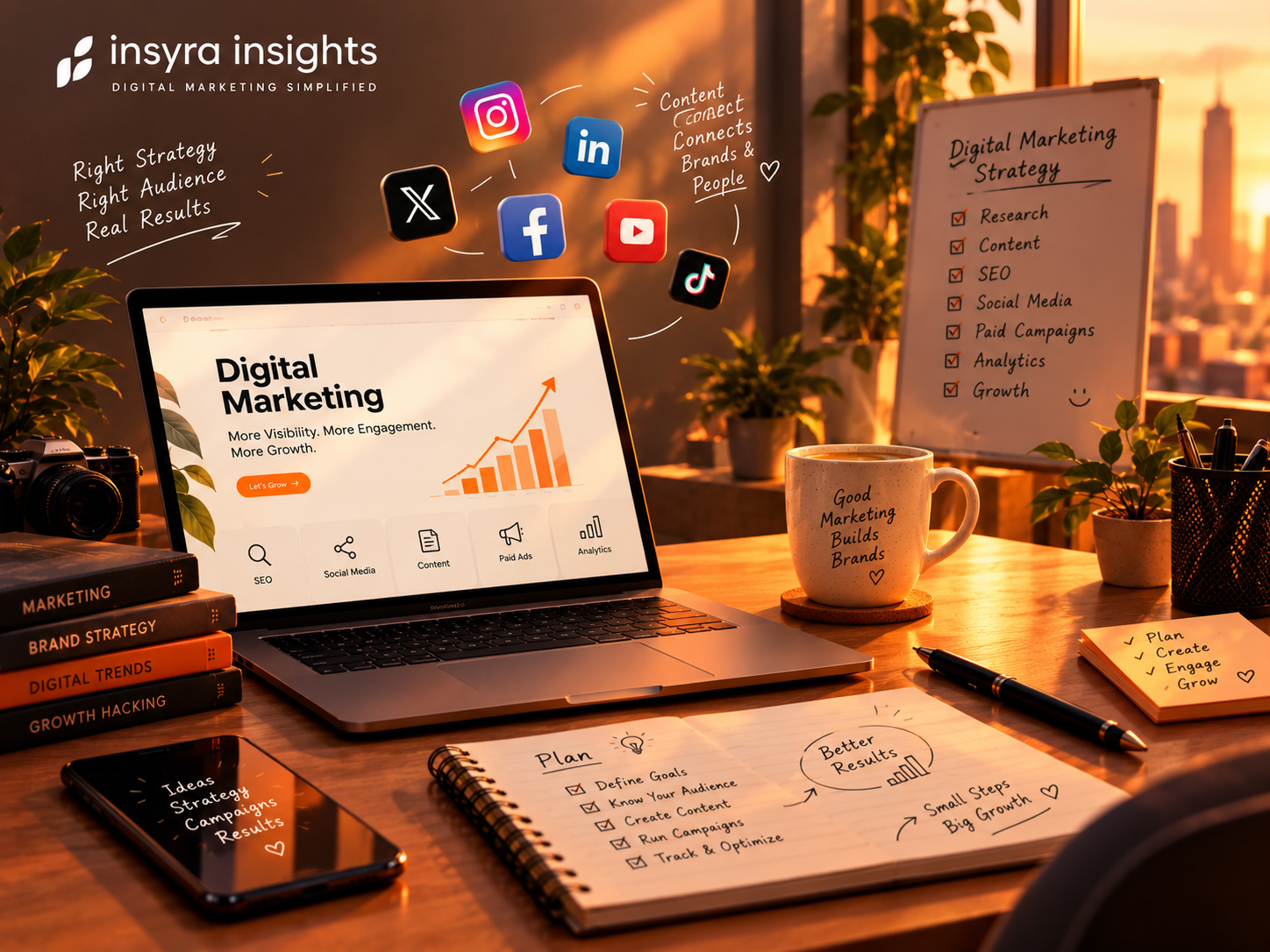
Digital marketing has changed the way businesses attract customers, build relationships, and grow. Whether you run a small local business, an e-commerce store, or a growing B2B company, having a strong online presence is no longer optional—it is an essential part of reaching your audience.
But digital marketing is more than simply posting on social media or running advertisements. Effective marketing combines strategy, content, search visibility, data, and customer experience to turn online attention into meaningful business results.
What Is Digital Marketing?
Digital marketing refers to promoting a business, product, or service through digital channels such as search engines, social media, websites, email, online advertising, and content platforms.
Some of the most important areas include:
- Search Engine Optimization (SEO)
- Content marketing
- Social media marketing
- Pay-per-click (PPC) advertising
- Email marketing
- Conversion rate optimization
- Analytics and performance tracking
The goal isn’t simply to generate traffic. A successful digital marketing strategy connects the right audience with the right message at the right stage of their buying journey.
1. Build a Strong SEO Foundation
Search engines remain an important way for potential customers to discover businesses.
SEO helps your website appear when people search for products, services, questions, or solutions related to your business.
A solid SEO strategy should include:
- Researching relevant search terms
- Creating useful, original content
- Optimizing page titles and headings
- Improving website speed and mobile usability
- Building a clear internal linking structure
- Earning relevant, trustworthy backlinks
- Regularly updating valuable content
Rather than trying to rank for every possible keyword, businesses should focus on searches that are genuinely relevant to their customers.
2. Create Content That Answers Real Questions
Content marketing works best when it provides genuine value.
Instead of creating content solely to promote your business, think about the questions your customers ask before making a purchase.
For example, a digital marketing agency might create articles about:
- How much SEO costs
- How to improve Google visibility
- Social media content ideas
- Common PPC mistakes
- How to measure marketing ROI
Useful content can attract organic traffic, establish credibility, and help potential customers understand why your product or service may be relevant to them.
3. Use Social Media Strategically
Social media gives businesses an opportunity to communicate directly with their audience.
However, being active on every platform isn’t necessarily the best strategy. Businesses should identify where their target customers spend their time and develop content suited to those platforms.
A balanced social media strategy can include:
Educational content: Tips, tutorials, and industry insights.
Engagement content: Questions, polls, discussions, and community-focused posts.
Brand content: Behind-the-scenes stories, company updates, and people.
Promotional content: Products, services, offers, and campaigns.
The key is consistency. A recognizable brand voice and useful content can help turn occasional viewers into an engaged audience.
4. Make Paid Advertising More Targeted
Paid advertising can help businesses reach potential customers quickly, but spending money doesn’t automatically produce results.
Successful campaigns start with a clear objective.
For example, your goal might be to:
- Generate leads
- Increase online sales
- Promote a new service
- Drive traffic to a landing page
- Increase brand awareness
Your advertising message, audience targeting, landing page, and measurement system should all support that objective.
Testing different headlines, creative formats, audiences, and landing pages can also reveal which approaches perform better.
5. Don't Ignore Email Marketing
Email remains a useful channel for nurturing relationships with existing and potential customers.
A good email strategy can include:
- Welcome sequences
- Educational newsletters
- Product updates
- Personalized recommendations
- Promotional campaigns
- Re-engagement emails
The focus should be on delivering something useful rather than simply filling inboxes. Relevant, well-timed communication is more valuable than sending large volumes of generic messages.
6. Measure What Matters
One of the biggest advantages of digital marketing is the ability to measure performance.
Businesses can track metrics such as:
- Website traffic
- Leads generated
- Conversion rate
- Cost per lead
- Customer acquisition cost
- Email engagement
- Advertising performance
- Revenue generated from campaigns
But metrics should always be connected to business objectives.
For example, a campaign generating thousands of visitors may look impressive, but if those visitors never become customers, traffic alone doesn’t tell the full story.
7. Think About the Entire Customer Journey
Digital marketing channels work best when they are connected.
A potential customer might discover your brand through a search engine, read one of your blog posts, follow you on social media, subscribe to your email list, and eventually become a customer.
That means your website, content, social media, advertising, and email marketing should provide a consistent experience.
Think of digital marketing as a system rather than a collection of separate tactics.
Final Thoughts
Digital marketing is constantly evolving, but the fundamentals remain surprisingly consistent: understand your audience, create useful experiences, communicate clearly, and measure the results.
Businesses don’t necessarily need to use every available marketing channel. A focused strategy built around the right audience and measurable objectives can be far more effective than trying to do everything at once.
At Insyra Insights, we believe digital marketing starts with insight and turns that insight into strategy, growth, and measurable results.